


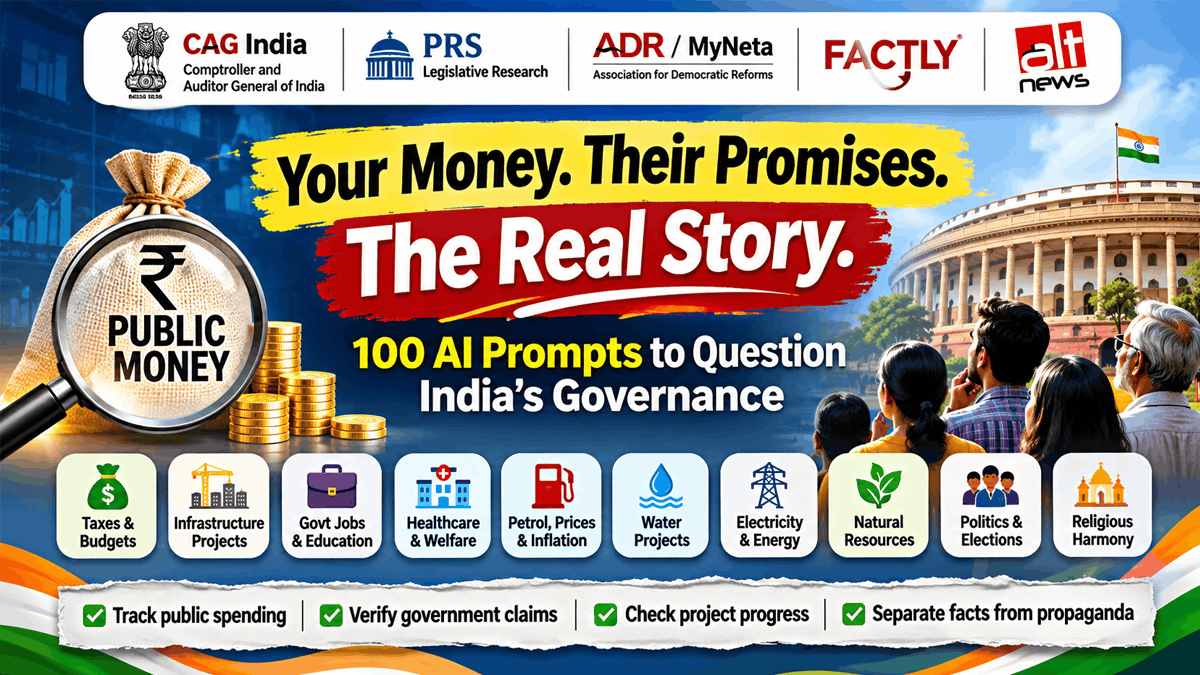
India’s public debate is full of claims: record development, historic spending, corruption allegations, religious polarisation, jobs created, projects completed and prices controlled. But what do the original records actually show?
**Your Money. Their Promises. The Real Story.** is a citizen-friendly research guide with 100 ready-to-use AI prompts. It helps readers investigate how public money is collected and spent, whether promises are delivered, what audits reveal, how political parties disclose funding, how essential goods and services change in cost, and whether infrastructure reaches people.
This is not a political-party ranking or an accusation against any government. It is a repeatable method for examining the Union Government, every State Government and local authorities by the same standards. Use the prompts one at a time in ChatGPT Deep Research, Perplexity or another research assistant, then verify the results against original documents.
**A crucial rule:** CAG audit observations are not automatically proof of theft or criminal corruption. A political allegation is not a court finding. A pending criminal case is not a conviction. A government announcement is not proof of completion. The prompts below require evidence status, dates, amounts, responses and source links to remain visible.
## How to use these 100 prompts
1. Choose one prompt and define the state, department, project, scheme or date range. 2. Use the latest five completed financial years where comparable audited data exists. Mark current-year figures as provisional, revised estimates or budget estimates. 3. Ask the AI to open original reports and cite page, table, paragraph or dataset references. Do not accept search snippets as evidence. 4. Compare the government's response and independent analysis. If a document cannot be found, record it as unavailable instead of guessing. 5. Publish a finding only after a human checks the original record, calculations, context and right of reply.
## The six core research organisations—and official data sources
**CAG India** provides statutory audit reports and findings on public expenditure, revenue, projects and public-sector entities. **PRS Legislative Research** explains budgets, bills, parliamentary work and state finances. **ADR / MyNeta** compiles candidate affidavits and political-party financial disclosures. **Factly** and **Alt News** help check public claims, statistics, images and viral content. Government portals such as **India Budget, DEA, RBI, MOSPI and data.gov.in** provide original financial and statistical records.
For prices, jobs, fuel, water, electricity, infrastructure and natural resources, the prompts also point researchers toward relevant official ministries, regulators and statistical agencies. These sources have different roles and methods; one should not be substituted for another. Always record the data's reference date and definition.
## 100 research prompts for citizens
The prompts are grouped into ten areas. Copy any prompt separately. The shared instruction for all prompts is: **be non-partisan; apply the same test to every party and government; cite primary records; distinguish fact, estimate, allegation, audit observation, investigation and judicial finding; include counter-evidence and the concerned authority's response; never invent missing figures.**
## What a useful public finding should contain
For every result, ask for: (1) the exact claim or question, (2) Union/State/local authority, (3) responsible department and administration during the relevant period, (4) financial year or event date, (5) exact amount and units, (6) original source and page/table, (7) calculation method, (8) government or party response, (9) independent counter-evidence, (10) current administrative or legal status, and (11) last-verified date.
## Read the numbers carefully
Budget Estimates are plans, Revised Estimates are updated projections, and Actuals are final reported expenditure when published. Gross tax revenue is not the same as the Union Government's net tax revenue after devolution. Borrowings are not tax collections. Installed power capacity is not actual electricity generation. A sanctioned water connection is not proof of regular safe water supply. A job notification is not a filled post. A project inauguration is not proof that the asset is operating.
## A practical starting point: investigate your own state
Begin with one district and one issue that affects daily life—drinking water, electricity bills, public transport, government vacancies, school facilities, hospital access or food prices. Find the official dataset, compare it with the budget and audit record, check independent fact-checks, and ask the responsible department for missing information through its public disclosure or RTI process. Expand to other states only when definitions and time periods are comparable.
**The purpose is not to tell citizens what to think. It is to give them a disciplined way to find out what happened, what was spent, who was responsible, what changed and what remains unproven.** Public money belongs to the public. Public accountability should be non-negotiable.
1–10. Start here: citizen accountability
Copy any prompt below into your AI research tool. Replace bracketed examples with the state, district, department, scheme, project or period you want to investigate.
- Prompt 1: Build a non-partisan five-year evidence map for the Union Government and every State/UT using CAG India, PRS, ADR/MyNeta, Factly, Alt News and original government data. Identify audited versus provisional years, missing records and link every primary document.
- Prompt 2: Compare previous and current administrations in [state] over equivalent periods. Map government tenure to financial years, budgets, actual spending and outcomes; do not attribute an entire financial year to one administration if power changed mid-year.
- Prompt 3: Create an evidence checklist for [government announcement]: original order, budget, tender, implementing agency, expenditure, completion certificate, independent audit and measurable outcome. Mark unavailable evidence instead of guessing.
- Prompt 4: Build a timeline of ten major policy decisions in [state] over five years. Record decision date, department, objective, legal/budget basis, milestones, spending and independently verifiable outcomes.
- Prompt 5: Map which source is best for each public question: CAG audits, PRS budgets and legislation, ADR/MyNeta affidavits and party filings, Factly/Alt News fact-checks, India Budget, DEA, RBI, MOSPI and data.gov.in. Explain limits.
- Prompt 6: Prepare a balanced evidence brief on [controversy]: original claim, primary records, independent analysis, official response, counter-evidence, legal status and unresolved questions. Do not treat repeated social posts as corroboration.
- Prompt 7: Map Union, state and local government responsibilities for [health/education/water/roads/electricity]. Identify who funds, regulates, implements and monitors each service.
- Prompt 8: Trace [scheme] from announcement to beneficiary: eligibility, approved budget, funds released/spent, beneficiaries, payments/services, exclusions, grievance data and audit findings. Distinguish targets from outcomes.
- Prompt 9: Audit source quality for [claim]. Classify each item as primary record, statutory audit, legislative analysis, fact-check, reporting, party statement or unverified post; explain its evidentiary value.
- Prompt 10: Design a searchable citizen dashboard filtering findings by government, department, year, administration, topic and evidence status. Include source links, last-verified date, corrections and allegation/audit/investigation/court-status labels.
11–20. Taxes, budgets, public money and debt
Copy any prompt below into your AI research tool. Replace bracketed examples with the state, district, department, scheme, project or period you want to investigate.
- Prompt 11: Analyse Union tax collections for five completed financial years. Separate gross tax revenue, states' share, net tax revenue, non-tax revenue, non-debt capital receipts and borrowings; reconcile BE, RE and actuals using India Budget, CGA, DEA and CAG.
- Prompt 12: For [state], break down SGST, state excise, stamp duty, vehicle taxes, central transfers, grants and non-tax receipts. Compare budget estimates with actuals using state finance accounts and PRS.
- Prompt 13: Explain the route from tax collection to expenditure, including Union taxes, state taxes, devolution, grants, cesses and surcharges. Distinguish gross collection from funds available to each government.
- Prompt 14: Compare tax growth with household income, inflation and nominal GDP/GSDP over five years using MOSPI and RBI. Calculate real growth where possible; explain why nominal growth alone does not prove improved living standards.
- Prompt 15: Examine cesses and surcharges: amounts collected, stated purpose, transfers/spending where disclosed and treatment in the divisible pool. Cite Finance Commission, Union budgets and accounts.
- Prompt 16: Analyse Union/state debt and interest burden: liabilities, guarantees, disclosed off-budget borrowings, interest payments, debt ratios and maturity risks. Distinguish debt stock, annual borrowing and fiscal deficit.
- Prompt 17: Compare departmental allocations with actual spending in health, education, agriculture, defence, transport, water and welfare. Identify underspending, supplementary grants and re-appropriations without equating spending with service quality.
- Prompt 18: Investigate government spending on advertising, publicity and events. Find department-wise budget heads, tender awards and audited actuals; distinguish public-information campaigns from party/candidate campaigning.
- Prompt 19: Analyse subsidies and direct-benefit transfers: budgeted amount, actual expenditure, beneficiary count, per-beneficiary value, arrears and evaluations. Check for double counting across schemes.
- Prompt 20: Create a taxpayer explainer for GST, income tax, customs, fuel excise, state VAT and local taxes using dated official rates and collection data. Do not claim an individual's tax is earmarked for one service.
21–30. CAG audits, procurement and alleged scams
Copy any prompt below into your AI research tool. Replace bracketed examples with the state, district, department, scheme, project or period you want to investigate.
- Prompt 21: Search CAG and Digital Reports for five completed financial years on financial management, procurement, revenue loss, project delays, excess expenditure and internal controls. Extract report, paragraph, page, department, amount, response and follow-up.
- Prompt 22: Investigate [public project] using CAG reports, DPRs, approvals, tenders, amendments, bills, completion certificates and court records. Reconcile approved/revised cost, actual spending, delay and operational status; do not call escalation corruption without evidence.
- Prompt 23: Create a register of CAG observations involving suspected diversion, irregular payment, inadmissible expenditure or revenue loss. Quote exact classification, amount and page; record department response and correction status.
- Prompt 24: Examine tendering in [department]: estimates, bidders, eligibility, winning bid, amendments, extensions, completion and payments. Identify red flags for inquiry, not proof of collusion.
- Prompt 25: Investigate delayed, abandoned or under-used public assets. Find sanctioned cost, releases, expenditure, physical progress, reasons, contractor and current public use.
- Prompt 26: Build a case-wise register of alleged government scams. Separate political allegation, CAG observation, FIR, investigation, chargesheet, trial, conviction, acquittal, appeal and recovery; never aggregate unlike legal stages.
- Prompt 27: Compare government's explanation of [procurement controversy] with tender file, audit, parliamentary answer, court record and fact-checks. Identify confirmed, disputed, unavailable and contradicted facts; include right-of-reply questions.
- Prompt 28: Analyse government guarantees, PSUs and contingent liabilities: issued/invoked/outstanding guarantees, defaults, recapitalisation and fiscal risks. Do not count guarantee face value as cash already spent.
- Prompt 29: Track CAG recommendations through PAC/Committee on Public Undertakings action, departmental reply, corrective order and subsequent audit. Mark implemented, partial, pending or untraceable.
- Prompt 30: Prepare a plain-language irregularity case file with exact audit wording, amount, period, report page, department response, later action, legal status and what remains unproven.
31–40. Political parties, elections and promises
Copy any prompt below into your AI research tool. Replace bracketed examples with the state, district, department, scheme, project or period you want to investigate.
- Prompt 31: Use ADR/MyNeta to compare declared assets/liabilities of candidates in the same constituency across elections. Note affidavit corrections and possible explanations; do not infer illicit wealth from an increase alone.
- Prompt 32: Compare party income, donations, expenditure and liabilities for five comparable years using ADR, party audit statements and ECI disclosures. Note accounting and disclosure gaps.
- Prompt 33: Analyse donations to national/regional parties by donor category and year using original filings, ADR and ECI records. Explain aggregated or anonymous categories; do not imply a donation proves a policy favour.
- Prompt 34: Investigate publicly disclosed political funding and corporate relationships using donations, electoral trust filings, company reports and policy timelines. Label possible conflicts as questions, not established quid pro quo.
- Prompt 35: Assess [party] manifesto promises after taking office. Define baseline, deadline, department, budget, implementation evidence and outcome; classify delivered, partial, not delivered, modified or unverifiable.
- Prompt 36: Use MyNeta affidavits to summarise candidate-declared pending criminal cases. Distinguish pending cases, charges, convictions and acquittals; remind readers pending cases do not establish guilt.
- Prompt 37: Compare election expenditure disclosures with statutory limits and ECI reports. Explain what returns include, what may be outside disclosed accounts and what cannot be independently verified.
- Prompt 38: Review MP/MLA performance using PRS and legislature records: attendance, questions, debates, bills and committee work. Explain why activity counts alone do not measure representation quality.
- Prompt 39: Build a dated timeline of defections and coalition/government changes using assembly records, Governor communications, court judgments and ECI documents. Explain procedure; do not assume illegality.
- Prompt 40: Create a citizen checklist for an elected representative using affidavit disclosures, legislative participation, constituency issues, public responses and documented legal/ethics outcomes. Avoid simplistic honesty scores.
41–50. Religion, communal harmony and misinformation
Copy any prompt below into your AI research tool. Replace bracketed examples with the state, district, department, scheme, project or period you want to investigate.
- Prompt 41: Build a verified register of public statements by political officeholders about religious communities. Preserve full speech/video, exact words, role, date, context, response, fact-check and ECI/police/court action; apply identical standards to all parties.
- Prompt 42: Investigate [viral communal claim] using Alt News, Factly and original media. Trace earliest upload, location, date, reverse-image/frame matches, edits and captions; classify authentic, old, miscaptioned, manipulated or unresolved.
- Prompt 43: Compare official crime statistics with independent hate-speech monitoring datasets without merging them. Explain definitions, collection methods, coverage and limits; do not present NGO monitoring as official NCRB counts.
- Prompt 44: Analyse election-time communal rhetoric in a defined period. Use transparent sampling, full-context speeches, consistent classification and ECI notices/orders; include public statements condemning religious hatred.
- Prompt 45: Investigate claims that [policy] favours/discriminates against a religious group. Read original law/order, eligibility, court decisions and implementation data; distinguish legal text from political interpretation.
- Prompt 46: Document calls for religious/economic boycotts: speaker, exact wording, audience, date, target, whether discrimination/violence was encouraged, official response and legal status.
- Prompt 47: Verify viral claims about worship places, conversion, demographic change or historical sites using original records, court documents, census data and specialist fact-checks. State when evidence is insufficient.
- Prompt 48: Investigate communal violence in [district] using police statements, public FIRs, court records, inquiry reports, compensation data and credible reporting. Separate allegations, confirmed facts, casualties, arrests and findings.
- Prompt 49: Assess official responses to communal tension: statements, preventive measures, law-enforcement action, relief, rehabilitation, prosecution and inquiry recommendations across comparable incidents.
- Prompt 50: Create a media-literacy guide for checking inflammatory content: source tracing, reverse-image search, date/location, full video context and Factly/Alt News verification. Advise pausing when evidence is incomplete.
51–60. Prices, inflation, fuel and household essentials
Copy any prompt below into your AI research tool. Replace bracketed examples with the state, district, department, scheme, project or period you want to investigate.
- Prompt 51: Track CPI inflation and a household basket for five years using MOSPI. Separate food, housing, transport, health, education and fuel; explain headline inflation versus price level and calculate cumulative change correctly.
- Prompt 52: Compare petrol/diesel prices across [cities] and dates using PPAC, petroleum ministry and OMC archives. Separate crude benchmarks, central excise, state VAT, dealer commission and retail price.
- Prompt 53: Break down petrol/diesel tax in [state]: central excise components, VAT/sales tax, cess, commission and freight where disclosed. Do not mix tax bases or dates.
- Prompt 54: Track rice, wheat, pulses, edible oil, milk, vegetables and cooking gas prices using Consumer Affairs, Agmarknet, FCI, MOSPI and official bulletins. Distinguish retail, wholesale, MSP and procurement prices.
- Prompt 55: Examine MSP, procurement, storage, distribution and retail prices using CACP, Agriculture Ministry, FCI and state records. Avoid unsupported causal claims about price changes.
- Prompt 56: Analyse LPG affordability: cylinder prices, subsidy eligibility/transfers, refill frequency and access by state/income group using PPAC, petroleum ministry and DBT data.
- Prompt 57: Compare domestic electricity bills across states using tariff orders, fixed/energy charges, fuel adjustment, subsidies and reliability indicators. Model transparent consumption levels.
- Prompt 58: Track public transport fares, tolls, rail fares and road user charges using official notifications. Compare effective dates and household affordability only with suitable income data.
- Prompt 59: Evaluate price-stabilisation measures: buffer stocks, open-market sales, import/export restrictions, procurement and retail trends using official records and independent analysis.
- Prompt 60: Build a city cost-of-living explainer for food, rent, transport, power, cooking fuel, education and healthcare using dated prices. Label the basket illustrative, not a national average.
61–70. Jobs, education, healthcare and welfare
Copy any prompt below into your AI research tool. Replace bracketed examples with the state, district, department, scheme, project or period you want to investigate.
- Prompt 61: Analyse employment trends using MOSPI PLFS: usual status, current weekly status, worker-population ratio, labour-force participation and unemployment. Explain definitions, sample design and limits.
- Prompt 62: Audit government recruitment promises: sanctioned posts, filled posts, vacancies, notifications, exam dates, cancellations, results, selections and joining using department reports and recruitment boards.
- Prompt 63: Investigate recruitment delays by building a timeline from vacancy notice to exam, result, appointment and joining. Separate government, PSU, contractual and outsourced jobs.
- Prompt 64: Evaluate job quality in [programme]: wages, contract status, social security, hours, retention, gender and region using PLFS, EPFO/ESIC where relevant, scheme data and evaluations. Do not count registrations as jobs.
- Prompt 65: Compare school spending with learning outcomes using UDISE+, NAS/ASER, budgets, teacher vacancies, facilities and attendance. Distinguish enrolment, attendance, learning and completion.
- Prompt 66: Investigate teacher vacancies: sanctioned posts, working teachers, subject gaps, pupil-teacher ratios and recruitment using UDISE+ and state education records.
- Prompt 67: Evaluate public healthcare capacity: hospitals, PHCs, doctors, nurses, beds, medicines, out-of-pocket expenditure and outcomes using MoHFW, National Health Accounts, HMIS and state records.
- Prompt 68: Audit welfare delivery for pensions, rations, scholarships or housing: eligibility, applications, approvals, rejections, waiting lists, payments, exclusions, grievances and social audits. Never expose beneficiary personal data.
- Prompt 69: Compare nutrition, child development and maternal health spending with outcomes using NFHS, WCD and health surveys. Explain year differences and avoid unsupported causation.
- Prompt 70: Assess higher education and skills: fees, scholarships, seats, completion, placement claims, apprenticeships and employment using AISHE, AICTE, UGC, Skill India and audited reports.
71–80. Infrastructure, water, electricity and transport
Copy any prompt below into your AI research tool. Replace bracketed examples with the state, district, department, scheme, project or period you want to investigate.
- Prompt 71: Create a tracker for major infrastructure projects: approval, original/revised cost, funding, tender, contractor, planned completion, progress, expenditure, delay reason and operational status using ministry dashboards, CAG and project records.
- Prompt 72: Audit drinking-water projects in [district]: sanctioned households, functional taps, quality tests, supply frequency, source sustainability, O&M costs and complaints using Jal Jeevan Mission, state boards and CAG.
- Prompt 73: Investigate [dam/irrigation/river-link] using DPRs, environmental clearances, rehabilitation, tenders, cost revisions, water allocation and actual irrigation outcomes. Distinguish designed capacity from delivered water.
- Prompt 74: Evaluate urban water and sewage: supply hours, non-revenue water, treatment capacity/throughput, quality, sewer connections and compliance using municipal bodies, pollution boards and CAG.
- Prompt 75: Analyse power generation, demand, reliability and finances using CEA, Ministry of Power, GRID-India, SLDC, DISCOM accounts and regulators. Separate installed capacity, generation, peak demand and outages.
- Prompt 76: Investigate DISCOM losses, subsidies and dues: AT&C losses, ACS-ARR gap, subsidy release, guarantees and arrears using PFC, CEA, regulators and audited accounts. Distinguish technical losses from theft.
- Prompt 77: Track renewable targets against commissioned capacity and actual generation using MNRE, CEA, SECI and state agencies. Separate announcements, signed, under-construction, commissioned and delivered capacity.
- Prompt 78: Assess highway projects using NHAI/MoRTH: kilometres sanctioned/awarded/completed, cost, tolls, maintenance, safety, land acquisition and mitigation; check CAG and contract variations.
- Prompt 79: Evaluate railway and public transport projects: funds, completion, ridership, punctuality, safety, accessibility, subsidy and last-mile connectivity using annual reports, CAG and state records.
- Prompt 80: Investigate flood-control, drainage, embankments and cyclone shelters: hazard maps, approvals, construction, maintenance, audits and performance during events. Compare announcements with risk reduction.
81–90. Natural resources, environment, land and agriculture
Copy any prompt below into your AI research tool. Replace bracketed examples with the state, district, department, scheme, project or period you want to investigate.
- Prompt 81: Investigate mining leases, auctions and royalties for [mineral/state] using Mines Ministry, IBM, state department, auction records and CAG. Track lease terms, production, royalty and compliance.
- Prompt 82: Analyse coal production, imports, dispatch and power dependence using Coal Ministry, Coal India, CAG, CEA and parliamentary answers. Distinguish reserves, production, dispatch and imports.
- Prompt 83: Examine oil/gas exploration, production, imports, royalties and public revenue using Petroleum Ministry, PPAC, DGH, PSU reports and public contracts. Distinguish reserves, resources and production.
- Prompt 84: Investigate forest diversion and compensatory afforestation: clearance, hectares, land identified, plantation survival, CAMPA funds received/spent and compliance using MoEFCC, PARIVESH, CAG and state records.
- Prompt 85: Assess environmental clearances for [project] using EIA, public hearing, clearance conditions, compliance, pollution monitoring, consent orders and court/tribunal decisions.
- Prompt 86: Analyse air/water pollution in [city/industrial cluster] using CPCB, state boards, monitoring and health datasets. State station coverage, pollutant definitions, period and gaps.
- Prompt 87: Investigate land acquisition and rehabilitation: notified land, compensation awarded/paid, possession, disputes, resettlement and livelihood restoration using official records, courts and CAG.
- Prompt 88: Evaluate farm investment and support: irrigation, subsidies, crop insurance claims, procurement, extension, soil health, market access and income indicators using Agriculture Ministry, states and surveys.
- Prompt 89: Examine groundwater extraction and recharge using CGWB, Jal Shakti and state authorities. Compare assessment categories, recharge measures, drinking-water dependence and trends.
- Prompt 90: Map natural-resource revenues and local benefits: royalties, auctions, dividends, environmental compensation and DMF funds to approved projects, actual spending and outcomes. Do not assume revenue stays in the source district.
91–100. Local services, transparency and public accountability
Copy any prompt below into your AI research tool. Replace bracketed examples with the state, district, department, scheme, project or period you want to investigate.
- Prompt 91: Evaluate municipal finances and services: property tax, user charges, grants, borrowing, water, waste, roads and drainage using audited accounts, state finance commission reports and CAG.
- Prompt 92: Investigate solid waste from collection to disposal: generated, segregated, processed, landfilled, dumpsites, contractor payments and compliance using CPCB, municipal data and audits.
- Prompt 93: Analyse grievance redressal using CPGRAMS/state portals: complaints, resolved, rejected, pending, disposal time and appeals. Explain that closure does not guarantee satisfactory resolution.
- Prompt 94: Review RTI performance using CIC/SIC reports and disclosures: applications, rejection grounds, delays, vacancies and compliance with proactive disclosure obligations.
- Prompt 95: Compare police and justice capacity using NCRB, BPR&D, India Justice Report and court statistics: vacancies, investigation, charge-sheet rates, pendency and legal aid. Explain definitions and avoid simplistic rankings.
- Prompt 96: Investigate road deaths using MoRTH, NCRB and traffic police: fatalities, injuries, black spots, enforcement, design and emergency response. Avoid causal claims from correlation alone.
- Prompt 97: Assess PDS performance using Food Department, NFSA, state data, social audits and CAG: allocation, lifting, distribution, portability, exclusion, audit findings and grievances.
- Prompt 98: Evaluate local-body funding: Finance Commission grants, state transfers, own revenue, plans, utilisation certificates, social audits and outcomes. Distinguish releases from expenditure.
- Prompt 99: Build a contract-transparency checklist: tender, bid result, award, work order, amendments, invoices, completion, quality tests and blacklisting. Identify missing disclosure stages.
- Prompt 100: Prepare a district public report combining revenue, jobs, prices, education, health, water, electricity, roads, environment and local services. Use comparable indicators, original sources, official responses and limitations.
Official and independent research source library
Open the original portals before relying on summaries. Use the most relevant source for each question and keep the original report or dataset link in your notes.